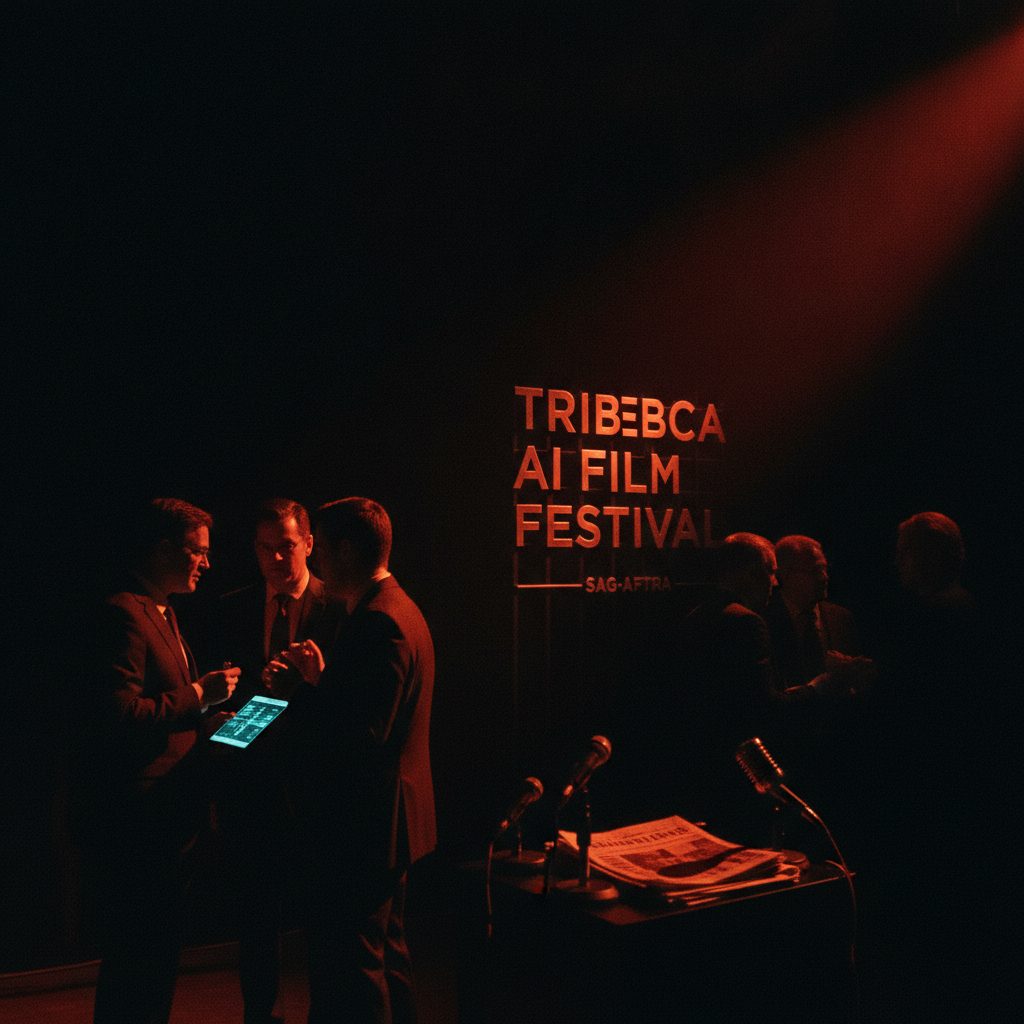
A 75-minute AI-generated docudrama just played Tribeca. Not the marketplace sidebar, not a late-night curiosity slot. The main program, at a festival celebrating its 25th anniversary. Anyone who's spent the past couple of years cutting AI footage into client work has watched this wall get lower and lower, but I didn't expect it to come down this fast.
"Dreams of Violets," produced by Fountain 0, follows Iranians who met during the January Tehran protests. It's fully AI-generated, live-action style, and it premiered at one of the three or four festivals that actually move industry opinion. A few weeks earlier at Cannes, Higgsfield's 95-minute action film "Hell Grind" screened through the Marché du Film, the trade marketplace, not the official selection. Getting into the marketplace means a festival will let you set up a booth. Getting into Tribeca's main slate means someone is judging your film as cinema. Those are very different doors, and one of them just opened.
How the industry is actually responding
Here's where it gets messy, and more interesting than the festival news. Tilly Norwood, the AI actor generating headlines since last year, just landed her first lead role in a feature called "Misaligned," playing an AI being with no body, no childhood, no lived experience, but access to everyone else's. SAG-AFTRA was not amused. The union put out a statement that Tilly "has no life experience to draw from, no emotion" and that audiences "aren't interested in watching computer-generated content untethered from the human experience." Equity in the UK took a softer line, pushing for transparency, consent, and remuneration rather than an outright fight.
A full AI feature got into Tribeca on artistic merit in the same stretch that an AI actor got torched by the largest performers' union in the country for trying to headline a comedy-drama. Nobody's landed on a consistent rule yet, which is why the reactions look contradictory rather than principled. If I had to bet, the industry ends up with quiet acceptance for AI as a production tool and continued hostility toward AI as a stand-in for a human performer's career. That split looks likely to define the next year of these fights.
The music industry didn't wait for a union fight to force its hand. On July 10, a coalition including IFPI, RIAA, A2IM, WIN, IMPALA, the Grammys, SAG-AFTRA, and the Human Artistry Campaign rolled out a voluntary labeling system splitting tracks into "AI-Generated" and "AI-Assisted." The timing makes sense once you see the numbers: AI-made tracks are now 44% of new uploads on Deezer and 33% on Apple Music. That's nearly half the catalog on one platform. The labeling scheme has real holes. It doesn't touch lyrics or composition, so a fully AI-written song stays unlabeled if a human sings it. But the intent is transparency over prohibition, which is the right instinct even with unfinished execution. Film and video credits will likely need the same conversation soon, and I'd rather the industry build that infrastructure now than get dragged into it after a scandal.
The tools are consolidating fast
On the tool side, the consolidation happened faster than expected. OpenAI shut down the Sora app and website back in April, and the API goes dark on September 24. Client projects that were pulling Sora footage last year have largely migrated to either Veo 3.1 or Seedance 2.0, both still being actively developed. ByteDance didn't stop there: Seedance 2.5 dropped this month with local editing and native 30-second generation, quietly fixing one of the more annoying limits of the last generation of tools. Short, choppy clips that needed to be stitched together in post.
Higgsfield, a tool that's become a regular part of a lot of production workflows, is taking the aggregator approach: 15+ models under one subscription, plus its own layer on top with Cinema Studio for camera control, Soul ID for character consistency, LipSync Studio, and a Claude MCP connector for pipeline automation. The lesson for anyone choosing tools right now is to stop chasing "best model." There isn't one anymore. Pick based on what you're actually making.
The harder problem is identity, not resolution
Raw video quality stopped being the interesting problem about a year ago. Everyone's output looks good now. What actually kills AI narrative projects is identity drift: a character's face subtly changing shot to shot, or their voice shifting tone between cuts in a way that breaks immersion the moment a viewer notices.
Two tools just made real progress here. Kling 3.0's multi-shot storyboarding with Voice Binding locks a character's voice across up to six cuts and five languages. Higgsfield's Soul ID lets you train a character once and reuse that identity across generations, which is useful on client work when the same "presenter" needs to appear across a multi-scene brand piece. Both are solving the same core problem from different angles: giving the model a fixed anchor point instead of re-guessing the character from scratch on every prompt.
For anyone trying to move past single clips into something with continuity, the workflow that actually holds up looks like this. Generate the character reference first, in isolation. Lock it into Soul ID or the model's equivalent identity tool before touching a single narrative shot. Build the shot list around that locked identity rather than prompting each shot independently and hoping consistency holds. Treat the character bible as a technical asset, not a creative afterthought. That one sequencing change is often the difference between a five-shot sequence that reads as one character and one that reads as five different actors wearing the same shirt.
The tools aren't the bottleneck anymore. Whether unions dig in, whether labeling spreads from Spotify to Netflix credits, whether festivals keep letting AI features into main slates instead of side rooms. Those questions will shape the next year of this industry more than whichever model wins the next benchmark.